 Dictionary
A4 (da. A4)
A4 is paper that measures 210 x 297 mm, the standard copy paper. The ration of the sides is 1 : squareroot(2). As a consequence, if the paper is bisected, the two new pieces have sides in the same ration. These smaller pieces are called A5. There is a whole series of paper starting with A0 which is defined by having an area of 1 m2. A0 and A1 (technical drawings, posters), A2 (flip-overs), A3 (drawings, diagrams, large tables, newspapers, large copy paper), A4 (copy paper, letters etc.), A5 (books, notebooks), A6 (books, postcards), A7, A8 (business cards). In origami particularly interesting because it is accessible everywhere. A number of models are designed for the A format, such as the arrow plane.
AEP (da. AEP)
Asociación Española de Papiroflexia, the Spanish folding society, see pajarita.com (a pajarita is a little bird, stylized as paper folding).
base (da. base)
Many models are constructed from a certain beginning, a base fold. The most well-known are the square base (or preliminary base), the waterbomb base, the bird base, the fish base, and the frog base. When designing a new model, one might start out with a base having the right distribution of points. E.g. the bird base has four points that may be used for head, tail, and two wings. The waterbomb base also has four points, but they are not good for a bird. However, it is easy to lock them together so you can blow up a spatial model like the waterbomb or the whale fish.
blintz (da. blintz)
Fold all corners to the centre. A standard method to store paper for later use.
book fold (da. bogfold)
Fold two opposite sides of the paper together. It opens like a book.
A technique to get more details and 3D-effects than from traditional base folds. By making a grid of squares with diagonals, corresponding to rows of the square base, the paper can be collapsed into shapes with box like extensions. A good example is Max Hulme's amazing jack-in-a-box. See also weekly fold 2007-44.
colours (da. farver)
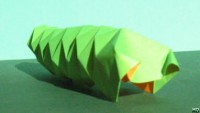
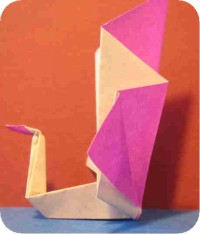
By default paper is uncoloured, often bleached (copy paper). Most origami is made from coloured paper, often with a white back opening for front/back effects, see e.g. Albert Schweitzer, the caterpillar, or the sumo wrestler. Other models like the flapping bird only exposes one side, and mono-coloured paper would suffice. Beautifully patterned paper can provide great results for e.g. birds.
crane (da. trane)
Together with the flying bird the most classic origami model. According to the Japanese legend he who folds a 1000 cranes will be granted a wish. The 1000 cranes became world famous when the Japanese girl Sadako Sasaki - ill by the bomb diseasy after Hiroshima - started folding cranes. In the popular version she did not finish before she died.
A line where a fold has been. The paper will forever remember where it has been folded, even when unfolded. Some creases are used later in the folding (pre-folding), others are just the result of a temporary fold and will not be used again. In the latter case you can often change the folding sequence to avoid the superfluous lines.
Making two reverse folds close to each other will crimp the paper. Often the two reverse folds will hit the mountain fold at the same point which will send the mountain fold in a new direction while retaining the same side of the paper on the outside, in contrast to single reverse folds.
Folding between to non-adjacent corners. In a square that will bring two opposite corners together.
A stylized, drawn illustration. Colloquially in origami often meaning folding illustrations in general, even if photographed rather than drawn.
DOC (da. DOC)
Danish Origam Center. In 1990-1994 the Danish origami society. Today replaced by foldning.dk.
A model in the shape of a regular polygon, often a hexagon (hexaflexagon), that can be flexed around so the facets or sides shift among each other. Gardner1964a describes how to make hexaflexagons from a strip of paper.
foil (da. folie)
Metal rolled out as paper. Usually paperbacked to improve the folding properties.
The sequence of folds made to construct a model. More sequences may lead to the same model. Some sequences can be easier to diagram or teach, whereas others may avoid unneeded crease lines.
The Danish origami society, founded 2010. See foldning.dk.
Literally origami backwards. Term invented by Thoki Yenn meaning an imaginative and creative person (word play on imagination) and friend (word play on amigo), see Kasahara2002. An alternative interpretation is due to Brian Mørk: Origami is the art of folding paper into small animals. Imagiro is the art of stamping small animals flat as paper.
inside reverse fold (da. inderknæk)
The inner reverse fold is made in a point by letting two mountain folds meet in the back of the point. This will turn the point the other way, starting inside the two original sides ( diagram).
Technique where paper is cut and folded, e.g. the cut dog inspired by Thoki Yenn who was a master of kirigami. Derived from Japanese kiru cut and gami paper.
large-scale origami (da. makrogami)
Folding very large pieces of paper, A0 and upwards.
Most traditional and many moderne folds are linear, i.e. the folding sequence is always going forward and adds more details. Examples include the flapping bird and the traditional lily. In contrast models like Kawasaki's rose and the passion flower lily is folded by first making a lot of precreases and then collapsing the model. The technique was made famous and refined ny Neil Elias for amazing creations.
Folding tiny paper, e.g. 5 mm or 10 mm squares. See weekly fold 2007-24. In 1986 in a contest for physicians associate professor Y. Watanabe (Anatomical department, Sapparo University) folded a crane from a just 1 mm square, using a needle under a microscope.
Member of Magic Circle and a clever paper folder. Owner of origami.dk.
Folding small paper, e.g. 4 cm or 8 cm squares available in ordinary shops.
model (da. model)
An origami model is what you fold a figure after.
Variant of origami where a number of like modules are folded and assembled to one figure. Typically ornaments and polygonal boxes are made this way. A popular variant of modular folding is teabag folding.
Folding from paper money. Typically models from 2x1 or 3x1 paper will be suitable, with minor adjustments. US Dollar bills are 156 x 66 mm.
mountain fold (da. bjergfold)
A fold formed by folding the paper backwards ( diagram). In diagrams marked as a dot dot dash line. One of the two basic folds, the other is its opposite, the valley fold.
nicotine animals (da. nikotindyr)
The notion of small animals, flowers etc. foldable in the air with no support and not diagrams, and which are used terapeutically in stead of smoking a cigarette. The concept of nicotine animals is invented ny Jacob Toft Pedersen.
From Japanese oru (to fold) and kami (paper), literally folding paper. In its pure form origami is the art of making figures from one square, white paper only by folding, that is, not cuts, no glue, no water, no drawing, no painting etc. In reality everybody creates his own rules. Nearly everyone uses colour, certain cuts are used to good effect, the popular teabag folding uses both many pieces of paper, and glue, and the properties of paper may be changed e.g. by wet folding.
outside reverse fold (da. yderknæk)
The outside reverse fold is made in a mountain fold in two valley folds starting in the sides and meeting in one point in the mountain fold ( diagram).
painting (da. maleri)
Flat origami where the contrast between the front and back of duo-coloured paper is used to "paint" a motive. See e.g. Mitchell2000 or Kasahara2004.
Fold paper tightly and dip into different colours to create beautiful patterns, like in standard tissue dyeing. Paper need not be bound as tightly as tissue, and you can experient with squeezers. See also Gaisser1977.
paper plane (da. papirfly)
1) An origami model that can fly. 2) An origami model depicting an airplane.
Sickly fear of paper. Not the best disease for a paper folder...
Folding instructions with photographed images instead of drawn diagrams. Often supplied with folding symbols such as lines or arrows.
Combination of valley- and mountain fold where the paper first is folded one way, then a bit further down the other way. Like a crimp fold. Repeat many times to get an accordion or fan fold.
Folding that is only marked and then unfolded again, typically because the paper afterwards is collapsed into a 3D model. See e.g. flower bowl 1. See also linearity.
rabbit ear (da. hareøre)
A folding technique where a corner is folded in such that the corner sticks into a new point as a [rabbit ear] ( diagram).
Passionate Danish master folder with a creative talent for the plastic-sculptural possibilites of origami. Used A-format a lot. Vieved origami from an aesthetical and meditative point. See Simon's pages. 1946-2013.
At a closed point (e.g. the top of the waterbomb base) an inside reverse fold is made on all sides going to the top, in effect pushing the point into the model.
When two layers meet in a mountain fold in a point, the pocket they form may be opened up and squashed flat. Can often be replaced with a precrease and collapse. See example in the traditional lily. Compare with pleat folds and crimp folds.
Fold wherd some paper that is not directly part of the folding line, is forced to swing along.
A popular form of origami where a number of modules are folded from teabags and arranged decoratively. A typical use is for beautiful decorations of postcards. See also weekly fold 2007-04, weekly fold 2007-30, and the group on facebook.
The oldest well-known Danish folder is Thoki Yenn. He was baptized Thorkild Søndergaard Jensen, but took the artist name Thoki Yenn. Originally a magician and kirigamist and has won a lot of prizes, including in Magic Circle Denmark. After meeting Lillian Oppenheimer 1958 he became obsessed of origami and is known e.g. for rectangulus umulius, the DNA fold, crossed box pleat, and not the least Kalmon, the drawn comic figure who wrote all his essays and drew his diagrams. In Denmark he started Dansk Origami Center in 1991 which unfortunately closed already in 1994. His home page is preserved at http://www.britishorigami.info/academic/thok/thok.htm, see also http://theory.lcs.mit.edu/~edemaine/thok/index.html. 1919-2004.
Folding towels into different shapes and figures. More like napkin folding than ordinary paper origami.
Technique where several folds a put into place at once by a rotating move. See e.g. Fujimoto's box.
valley fold (da. dalfold)
A fold formed by folding the paper forwards ( diagram). Diagrammed as a dashed line. The valley fold is one of the two basic folds. The other is the opposite, a mountain fold.
washi (da. washi)
Hand made Japanese paper.
A base fold for many origami models ( diagram). The paper is folding in two mountain diagonals and one valley book fold, and then collapsed into a triangle. The opposite of the square base.
Folding technique where the paper is dampened before and during the folding e.g. using a damp cloth or a fine sprinkler. Thereby the paper has more plasticity and unneeded creases become less visible. Some models can only be made using damp paper. Of course the paper and the colours must endure water. The more extreme examples begin to look like papier mache.


 Origami Alfresco

 The Art and Wonder of Origami





 Papirfoldning




 Papirbatik

